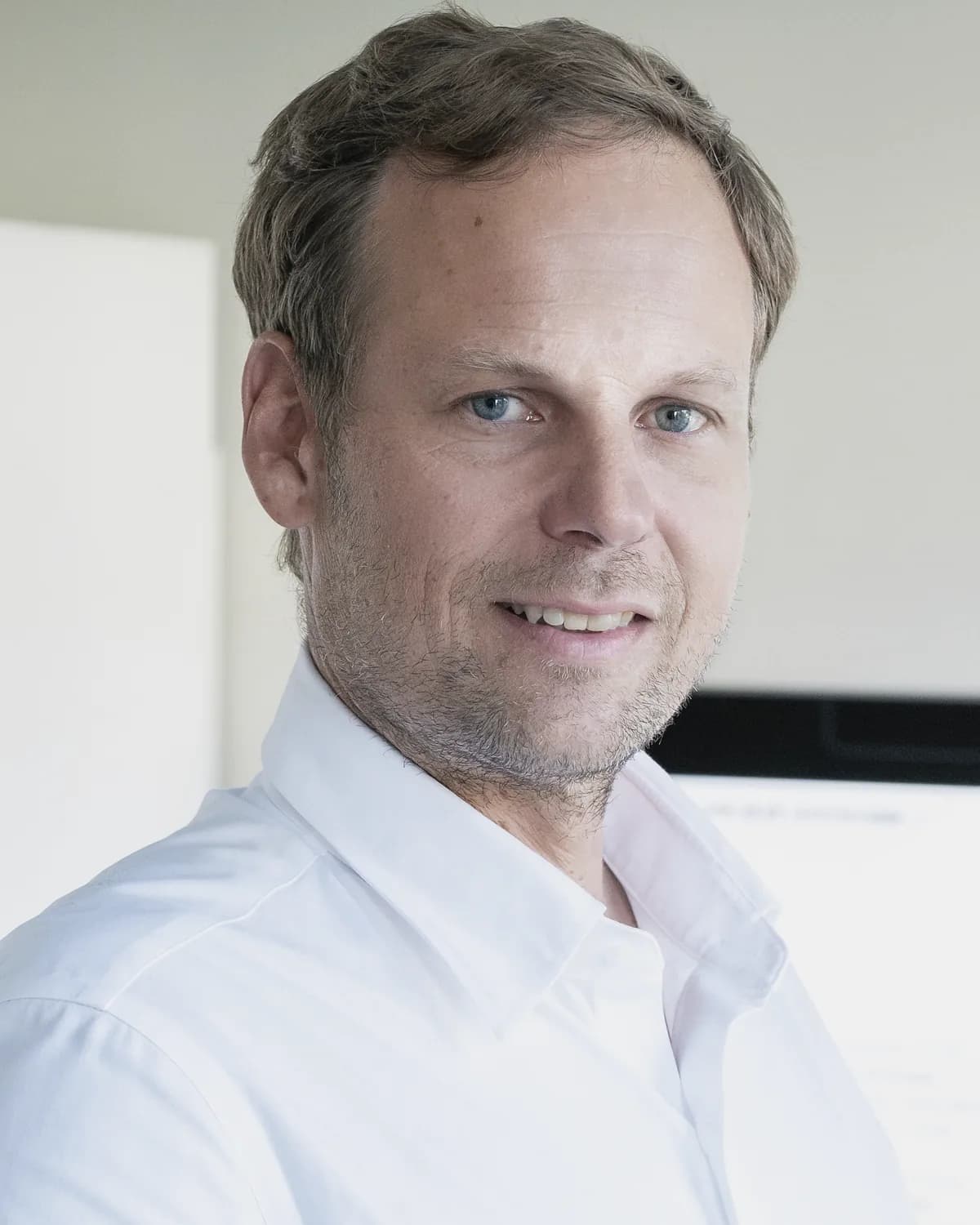
Stéphane Schwander.
Nine years at UEFA in Nyon, from 2005 to 2014, first as an application specialist on UEFA.com, then as Digital Operations Manager: everything published on the site, in twelve languages, across some 1,600 matches a season and around sixty contributors in Europe, with a EUR 2.1 million budget.
Eleven years at the FEI, the international federation for equestrian sport: Commercial Manager, Digital Partnerships from 2015 to 2017, Head of Digital from 2018 to 2024, then Head of Content and Platform Management until 2026, with a team of fifteen across Lausanne, Germany and England and a CHF 2.5 million budget.
Before that, founder of WNG, a web and new media agency in Lausanne started in 2001 and built to CHF 1.9 million in turnover with a team of nine. Vendor, operator, executive: I have written the recommendation, executed it, and been the one who had to defend it upstairs.
The FEI years.
When I joined the FEI, equestrian sport reached its audience the way most Olympic sports still do: through broadcasters, on their terms, in their windows. The federation could prove it was being watched a few weeks every four years. It could not prove much else.
Over eleven years we turned the federation into its own media platform. The owned audience grew from 351,000 to 5.3 million. We founded the FEI Media House, a joint venture with ClipMyHorse.TV, so that production was something we controlled rather than access we had to request. And we built commercial inventory on those channels: the media offer booked over CHF 1 million in its first ten months, with seven partners each receiving a delivery report against their own name.
The proof came when the spending stopped. In my final year we cut paid media spend by 78 percent, and the audience still grew by 7 percent. By then, 81 percent of our video consumption ran through channels we owned, while the sport's mainstream television coverage fell by a quarter to a half in a single cycle. Measured independently for ASOIF, the operation performed in the first quartile of Olympic international federations on owned channels.
That work is the origin of the EvidenSe thesis. It proved that visibility and value are built separately, that owned demand is worth more than rented reach, and that none of it survives unless the case can be defended in front of a board, a congress and a budget. I defended those budgets, briefed those boards and lived with the consequences.
Consultants have the models but have never carried a decision through a congress. Federation insiders have the credibility but not the modelling. EvidenSe works in the overlap.
Beyond the practice.
I lecture at Toulouse Business School, and have given guest lectures at the Institute of Sport Sciences of the University of Lausanne, invited by Professor Markus Lang. At ThinkSport, the Lausanne-based international sport cluster, I mentor start-ups in the TECH4SPORT Accelerator and sit on the Sport Innovation Challenge Council. I also advise start-ups directly, currently as adviser to PickEat.it.
The two feed each other. Teaching forces the thesis to be explainable to someone with no stake in agreeing with it, and a founder's board asks harder questions about revenue than most congresses do.
The FEI work took Best Entertainment, Leisure and Travel Campaign at the Alliance of Independent Agencies awards in London in 2022, for a campaign that used 30 percent fewer posts than its predecessor and reached 96 percent more people. I trained in Leading Digital Business Transformation at IMD in Lausanne.
How I work.
No overclaims.
A verifiable fact is worth more than an impressive adjective. If a claim cannot be checked, it does not go in the recommendation.
Advisory only.
EvidenSe advises. It does not resell technology, take implementation mandates or carry a stake in the outcome it recommends.
AI as accelerator, not headline.
Modelling and AI make the evidence work faster and more systematic. They are method, never the promise.
Verification over generation.
Anything a model produces is checked against sources before it reaches you. The recommendation is argued, not generated.
Start with a conversation.
Thirty minutes. No material required in advance. If a sprint is not the right answer for where you are, I will say so.